
Debs Invites Arrest
The 1918 prosecution of Eugene Debs under the Espionage Act—and Justice Oliver Wendell Holmes's later change of mind—is the first moment explored in a new, four-module teaching guide on the contested history of free speech in America.
Clyde Miller hated what he was hearing. It was June 1918, and the U.S. had been at war for a little over a year, and the man on the platform in the park in Canton, Ohio was speaking — passionately, mockingly — about the many ways that the war had undermined the rights of American citizens. Socialists had been sent to jail for criticizing the war, complained Eugene Debs, the most famous Socialist in America: “It is extremely dangerous to exercise the constitutional right of free speech in a country fighting to make democracy safe in the world.” There was knowing laughter from the crowd of picnicking socialists.
Miller wasn’t laughing. A pro-war journalist and a member of the nationalist American Protective League, which served as a civilian auxiliary to the security state, Miller had spent the war trying to stamp down on anti-war dissent of the sort Debs was now claiming deserved protection under the First Amendment. And so Miller tried to shut Debs up, too. “Debs invites Arrest” was the headline he put on his story about Debs’ speech in the park. And Miller went a step further, writing to a federal prosecutor to ask that Debs be charged under the Espionage Act, like so many other socialists during the war.

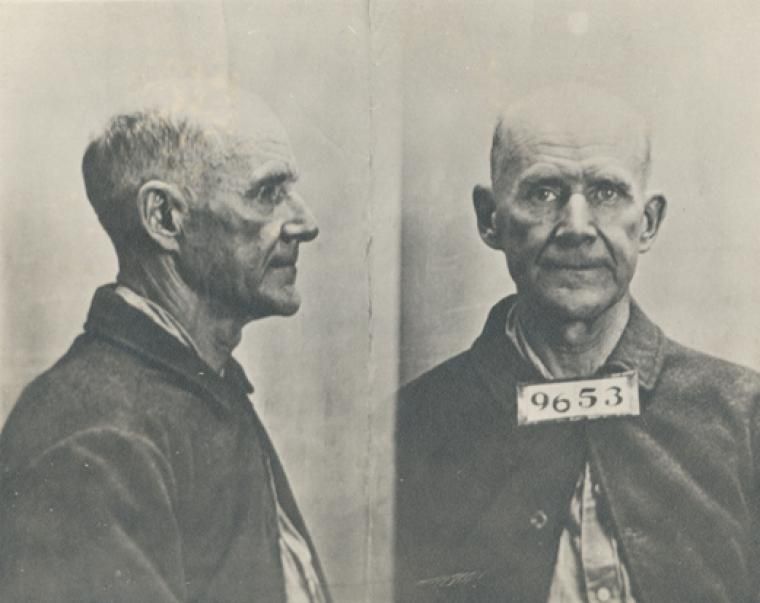
A mugshot of Eugene Debs, courtesy of the New York Public Library.
Two weeks later, Debs was arrested on his way to give another speech in Ohio. He was found guilty and sentenced to 10 years in jail. His crime? Although he was charged under the Espionage Act, there was no suspicion that he was a spy, or a paid agent of a foreign government. But by criticizing, admittedly mildly, the war effort, Debs’s speech might have sapped the morale of draft-age men and thus interfered with the draft—a crime under the Espionage Act. In 1919, the Supreme Court unanimously upheld his conviction.
The Debs case is an important moment in the history of free speech in the United States. A clash over wartime speech led to a Supreme Court decision, which itself was soon subject to criticism by an only-just-emerging civil liberties movement. That criticism in turn would lead the author of the Supreme Court’s opinion in the Debs case—Oliver Wendell Holmes—to change his mind about free speech and to issue some famous, stirring dissents in which the seeds of the modern First Amendment were planted.
It is also a wonderfully rich teaching moment, a place to see how different attitudes to free speech used to be, and to be reminded of the ways that Americans have disagreed about what the right to free speech covers, and what sorts of speech can be punished to protect the national security and the public good. Both Miller and Debs thought they knew where those lines were and where they should be—they had competing ideas about free speech. Justice Holmes, too, thought he knew what free speech meant, until he changed his mind, and with it the future of the law.
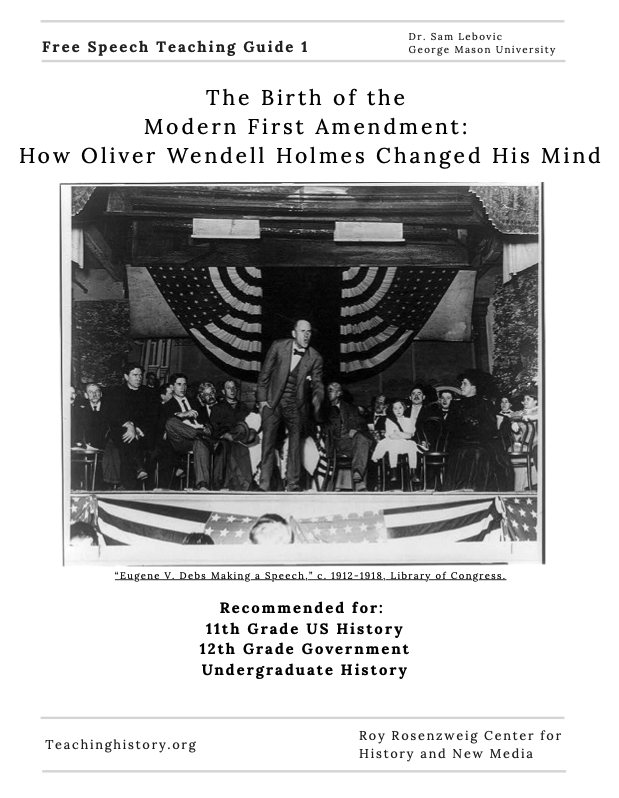
The first of four teaching guides about the history of free speech, this teaching guide describes how Oliver Wendell Holmes changed his mind because of Eugene Debs.
Engaging with these competing understandings of free speech thus provides students an opportunity to reflect not only on the history of the First Amendment but on their own philosophy of free speech as well. Through close reading of primary sources, contextual essays, and guided exercises, this teaching guide gives instructors the material to help students understand this historical moment, as well as the broader philosophical and political problems posed by the prosecution of Debs for speech crimes during World War I.
Nor are the lessons to be learned confined to World War I. The issues raised by the Debs case recurred throughout the twentieth century, and they are still with us today. What is the line between national security and civil liberty? Can national security secrets, like the Pentagon Papers, be published in the newspaper? Can individuals, like a Klansman advocating racial violence, be prosecuted for advocating crime? Can the government deny a visa to a foreign radical because of their political beliefs? The four modules in the free speech guides take up these and other important questions in the history of free speech, providing students with an introduction to the historical evolution of First Amendment law, as well as insight into some fascinating moments in American political history.