
How To Make an Academic Zine for a Public Audience
Zines offer academics a creative and accessible way to share research with broader audiences. This guide introduces the basics of creating an academic zine, from planning your content to designing an engaging final product.
If you’re at all familiar with the fiercely independent, anti-institutional history of the zine, you might reject the supposition that they can be used within academic circles. Yet zines have potential as a creative, cohesive outlet for public history.
Zines originated around the 1930s in science fiction circles but are most often associated with the latter half of the twentieth century. Used as an alternative art form outside of mainstream media, zine authors from the 1960s through the 1990s used self-publishing to broadcast bold ideas through small, often collaborative, pamphlets. Zine topics could range from birth control to bus routes, but almost always were intended to communicate something significant from the creator to the outside world. For a brief history of zines, visit the Rare Book Collection at UNC Libraries.
Diverse in their substance and purposes, zines offer academics a creative—even fun!—outlet for sharing their work. Even teenagers have shown rapt interest in academic work when I have shown them a table full of zines. The accessibility of layered imagery, shortened text, and visual appeal benefits the reader—and widens the traditional audience for academic research.
If it’s your first time, making a zine may seem overwhelming. Yet a zine can take any format or shape that you desire. The point of a zine is that it defies traditional, methodical publishing by letting the creator freely improvise.
As an entry-level cheat sheet, I’ll walk you through the anatomy of an academic-style zine with a step-by-step process.
Step One: Choose Your Topic and Your Desired Format for Creation
Do you want to design the zine online in a digital format and then print it out? Or would you like to design the zine with paper and mixed materials before scanning and printing for multiple copies? Feel free to experiment with both options before making a final choice.
Step Two: Figure Out What You’re Trying to Say—Then Shorten It
Zines are small and lack the space for your entire academic essay or the extent of your research findings. Don’t worry about getting all of your research onto the page. Pull out the most necessary (and the most widely interesting) pieces and stitch them together into a narrative text.
Decide who your audience is and cater the information towards them. If you’re using the zine at an academic conference, you can keep the language relatively high-level. If you’re bringing the zine to a high school or university for a presentation, make the text accessible for your audience.
Step Three: Get Creative!
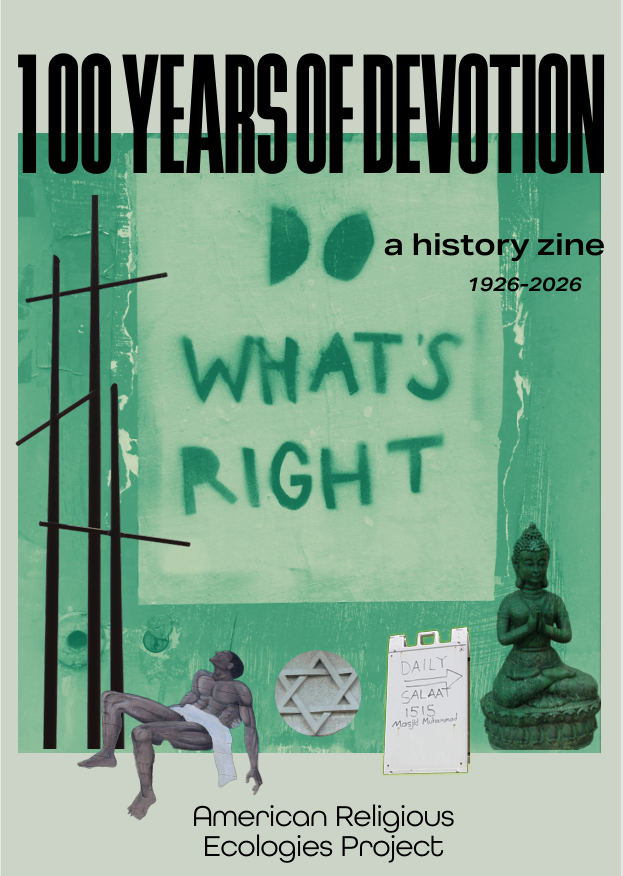
Lay out the text amidst layered images, cut-out letters, open-access photographs, digital art, and hand-drawn lines. Don’t be afraid to incorporate historical imagery. You can always cite the photographs below the image or in a separate section at the end of your zine. Experiment with color, scale, and image. Once you have the text interspersed with design, you’re almost done!
Step Four: Incorporate Guideposts to Additional Information
At the end of your zine, or on the back page, make sure to provide information about how to access more of your work. Include an organizational website, a link to your research article, your affiliated university program, or your personal webpage. Make sure that the reader can find you and your work online—or at the very least, that they can contact you with further questions about your research.
Since zines often don’t have the space for all of your research, it is essential for academics to include options for further outreach and information.
Once you complete this option, you’ve done it! You’ve made a zine. Distribute them locally and enjoy the one-of-a-kind media that you have created.
If you’re seeking inspiration (or a simple example), I’ve attached a short zine that I created for the American Religious Ecologies Project here at the Roy Rosenzweig Center for History and New Media. I designed the zine digitally using Adobe InDesign and then printed it on a standard printer. They were a great physical handout for my poster presentation at the DC History Conference and can be reused in the future as a way to share a short overview of my research with new audiences.