

RRCHNM Associate Directors Awarded Book Prizes
Death by Numbers Receives Renaissance Society of America’s Digital Innovation Award

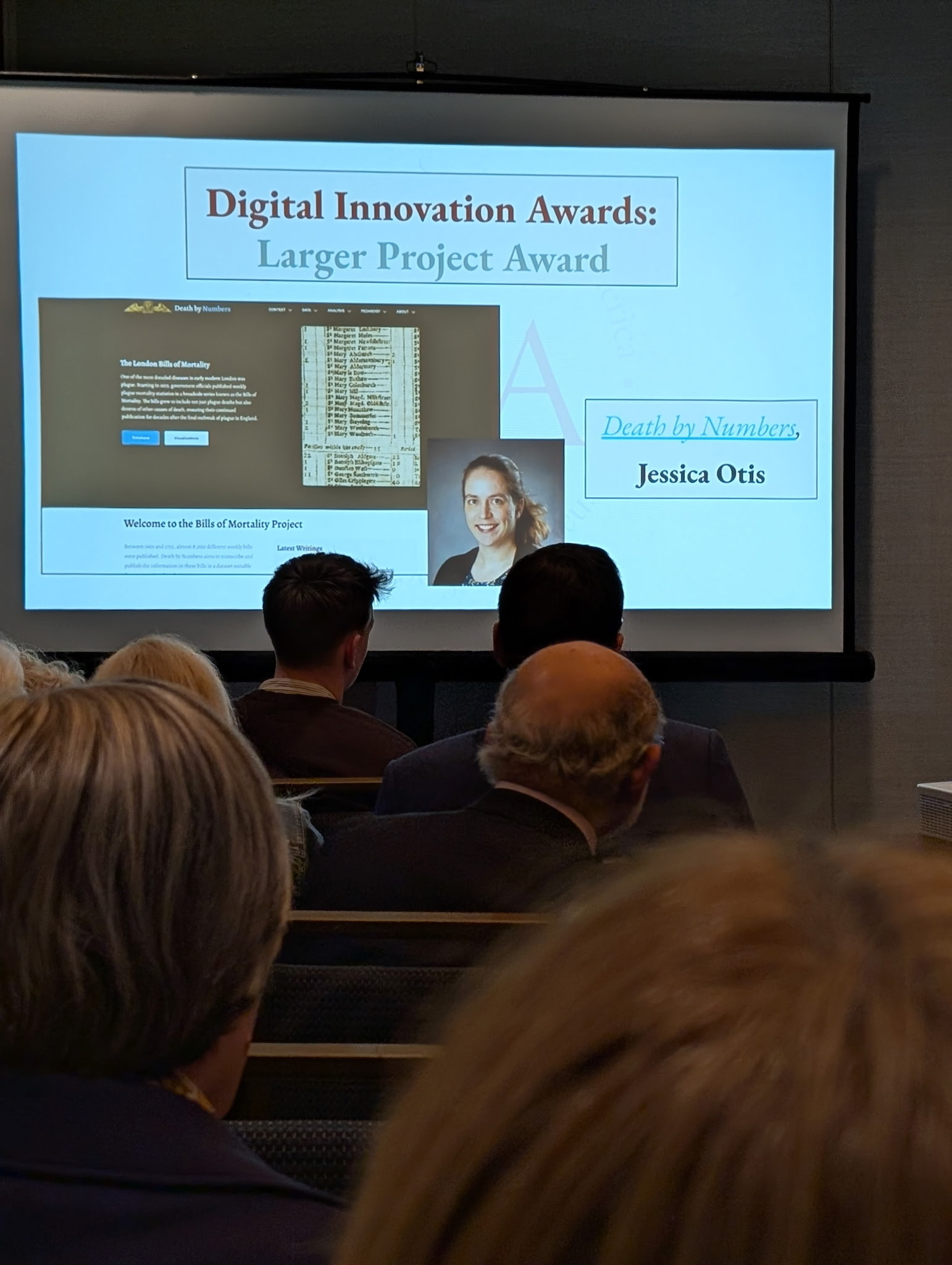
Death by Numbers has been awarded the Renaissance Society of America’s Digital Innovation Award for 2026. This award “recognizes excellence in digital projects that support the study of the Renaissance.” Jessica Otis, associate director of RRCHNM, accepted the award this past month at the Renaissance Society of America’s Annual Meeting.
Death by Numbers is a project focused on London’s historical Bills of Mortality, a series of weekly documents that recorded cause-of-death statistics in the city. The bills began publication in 1603, initially to track plague mortality, but eventually expanded to cover dozens of other causes of death. This project’s goal is to transcribe and publish data from nearly 8,000 weekly bills published between 1603 and 1752, creating an open-access dataset that makes these extensive historical records available to scholars for new analyses.
Harlem in Disorder awarded Ángel David Nieves Book Award and honorable mention for the Mary L. Dudziak Digital Legal History Prize

Dr. Stephen Robertson’s Harlem in Disorder has garnered major recognition in the digital history, winning the Ángel David Nieves Book Award from the American Studies Association and receiving an Honorable Mention for the Mary L. Dudziak Digital Legal History Prize from the American Society for Legal History. This groundbreaking digital monograph examines the violence that erupted in Harlem on March 19, 1935, the first large-scale racial disorder in the United States in more than a decade. Through a granular analysis of those events and the mapping of their locations, Harlem in Disorder: A Spatial History of How Racial Violence Changed in 1935, reveals that Harlem’s residents participated in a complex new mix of violence that was a multifaceted challenge to white economic and political power. Harlem in Disorder was published open-access by Stanford University Press in 2024 and demonstrates how the digital medium can be used to create a multi-layered monograph that captures historical complexity and makes historical interpretation transparent.